
The digital marketing trends defining 2026 are the migration of search behaviour into AI engines, the shift from AI experimentation to AI operations, flat budgets forcing technology consolidation, and the rebuilding of measurement around visibility rather than clicks.
Halfway through the year, there is now enough data to separate the trends that materialised from the ones that stayed on conference slides.
This is a mid-year briefing for marketing leaders at larger organisations: what the data shows on each trend, and what to do about it in the second half of 2026.
What are the biggest digital marketing trends in 2026?
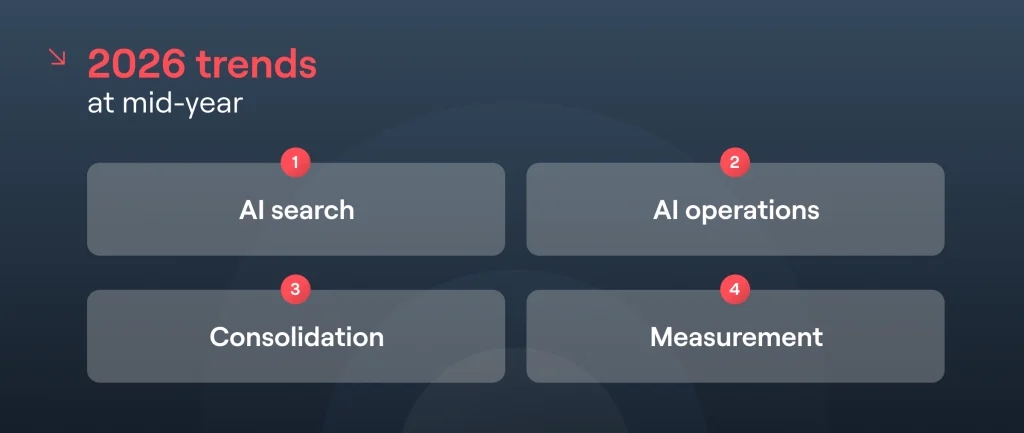
Four trends have proven themselves in the data by mid-2026: (1) search behaviour migrating into AI engines and zero-click experiences; (2) AI moving from pilots to marketing operations, exposing a readiness gap; (3) flat budgets forcing martech consolidation onto fewer platforms; and (4) measurement shifting from clicks and traffic to visibility, influence and revenue.
Each is examined below with the evidence and the action it demands.
Trend 1: Search is migrating into AI engines — and most of it no longer clicks
In the first four months of 2026, 68% of US Google searches ended without a single click to the open web — up from around 60% in 2024, the fastest acceleration in a decade.
AI Overviews now appear on more than a fifth of searches, and when they do, click-through rates fall by nearly 60%. Users click a website on just 8% of searches showing an AI summary, against 15% without one.
For marketing leaders, the implication is uncomfortable but clarifying: a growing share of your buyers now form their shortlist inside an AI answer, before your analytics ever see them. Ranking well is no longer the same thing as being seen.
The brands being named, cited and recommended inside ChatGPT, Gemini, Perplexity, and Google’s AI surfaces are winning consideration invisibly.
That is why Answer Engine Optimisation has moved from novelty to line item. It is a distinct discipline — measuring which buyer questions your brand appears in, fixing the technical basics that block AI crawlers, and structuring content so it can be cited.
We’ve published what happened when we applied this to our own site: measured AI visibility, found our own robots.txt blocking AI crawlers, fixed it, and moved the numbers within six weeks.
Trend 2: From AI experimentation to AI operations
Gartner’s 2026 CMO Spend Survey puts hard numbers on a shift every leadership team is feeling: CMOs now allocate 15.3% of marketing budgets to AI, and 70% call AI leadership a critical goal for 2026.
Yet, only 30% report mature AI readiness, and 70% admit their internal processes aren’t ready to implement and scale AI.
The gap between ambition and readiness is where 2026’s winners and losers are being decided. The organisations pulling ahead aren’t simply spending more (though the AI-mature cohort does allocate 21.3% of budget to AI); they’ve done the unglamorous work first — unified customer data, governed processes, and teams trained to use AI inside the systems where work actually happens, rather than in disconnected pilots.
In practice, that means the AI conversation is now a data and platform conversation. AI embedded in your CRM can only be as good as the data foundation beneath it.
Before scaling AI use cases, audit whether your customer data is unified, deduplicated and governed enough to trust the outputs.

Trend 3: Flat budgets are forcing stack consolidation
Marketing budgets are effectively flat at 7.8% of company revenue in 2026 (7.7% in 2025) — 18% below the mean of four years ago — and 56% of CMOs say they lack the budget to deliver their 2026 strategy.
Meanwhile, martech’s share of budget has fallen to a five-year low of 19.4%, even as 62% of CMOs plan to invest more in marketing technology.
Those numbers only reconcile one way: consolidation. Leaders are cutting overlapping point solutions and concentrating spend on fewer platforms that do more — reducing licence sprawl, integration overhead and the data fragmentation that undermines Trend 2.
The rise of consumption-based martech pricing sharpens the same discipline: every tool must earn its usage.
If your stack has grown by accretion — a tool per team, per campaign, per year — the second half of 2026 is the time for a platform audit: what does each tool cost fully loaded, what would consolidation onto a unified platform save, and what does fragmentation cost you in unusable data?
Our guide to evaluating enterprise CRM platforms covers the total cost of ownership questions to ask.